Do you need to be a midwife to teach parents about birth?
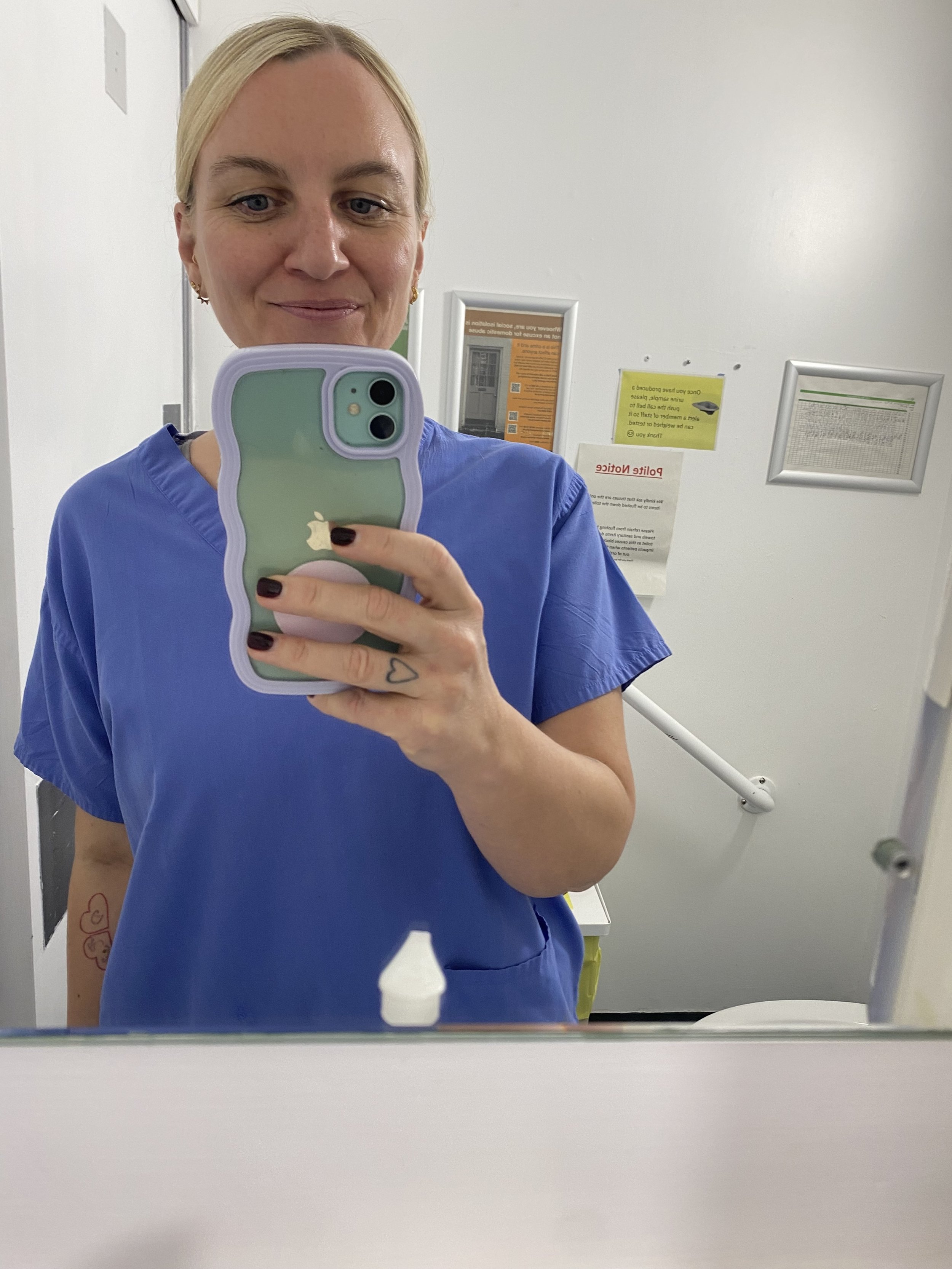
Our founder Sam in scrubs supporting a caesarean birth!
I remember googling “how to become an antenatal teacher” and being absolutely convinced that I was about to discover that I needed a qualification that I didn’t have and that was hard to achieve. I was expecting that I needed a midwifery degree, or ten years experience on a labour ward, or at the very least four children?!
What I did have was a newborn, an obsession with birth that had basically taken over my personality, and absolutely no idea whether anyone would take me seriously. I could happily spend an entire evening reading about birth, but imagining myself standing in front of a room of expectant parents and teaching them about it felt like quite another thing!
If you’re here because you’ve been wondering whether you can become an antenatal teacher without being a midwife, I know how much can sit behind that question. You might be thinking about changing careers, trying to find work that means something to you, or wondering whether this interest in pregnancy and birth could ever become more than something you read about on your phone.
You do not need to be a midwife to train as an antenatal teacher.
You do need to develop the knowledge, teaching skills and professional boundaries to do the work well, but you don’t have to arrive with a clinical background or a particular birth story to your name.
Do you need a healthcare background to become an antenatal teacher?
Most of our students at The Perinatal Academy come to us without a healthcare background. We also have some incredible midwives who train with us, and their experience is very welcome, but it isn’t a prerequisite for joining our antenatal teacher training.
People arrive from all sorts of careers and stages of life. Some have spent years in an office and can no longer imagine doing the same thing forever. Some are on maternity leave, wondering what returning to work might look like. Others already work with families and want to develop their knowledge so they can offer antenatal education alongside their existing work.
You may already have experience that will help you, even if it doesn’t look particularly birth related on paper. Listening carefully, explaining something without making someone feel silly, organising a group, working with different personalities and helping people feel comfortable enough to ask questions are all useful skills in an antenatal classroom.
There will be plenty to learn, of course. That is why you train! You aren’t expected to turn up on the first day already knowing everything you hope to teach.
What is the difference between an antenatal teacher and a midwife?
Part of the confusion comes from the fact that both roles can involve talking to parents and supporting them with pregnancy, birth and their choices. Midwives can and do teach antenatal classes, and many do, alongside their clinical work, but genuinely, being a midwife doesn’t automatically make them a ‘better’ antenatal teacher.
As an antenatal educator, your role is to help parents understand birth and early parenthood, explore their options and prepare for conversations with their maternity team. That will include teaching about the physiology of labour, comfort measures, pain relief, induction, caesarean birth, birth partners, feeding and the early postnatal weeks.
You need to be able to explain these subjects clearly and thoughtfully, including where there is uncertainty or where somebody’s individual circumstances will affect the options available to them. You also need to recognise when a question belongs with a midwife, doctor or another appropriately qualified professional.
An antenatal teaching qualification does not qualify you to assess someone’s pregnancy, diagnose a complication or recommend an individual treatment plan. Understanding those boundaries is part of becoming a knowledgeable, trustworthy educator.
There is enormous value in giving parents time to learn, ask questions and work out what matters to them, alongside the clinical care they receive. It can literally change someone’s birth or postnatal experience for the better!
Do you need to have had a baby to teach antenatal classes?
You don’t need to have given birth to train with us, and you don’t need to have experienced a particular type of birth either.
I think this matters because people can quietly rule themselves out for all sorts of reasons. Perhaps you had a planned caesarean and wonder whether you could teach about experiencing labour. Perhaps you didn’t breastfeed, or you don’t have children, and worry that parents will expect you to have personally experienced everything you discuss.
Your own experience can be a useful part of what you bring to this work, but it cannot be the whole foundation of your teaching. Every family you meet will have their own circumstances, priorities, beliefs and experiences, and they deserve education that makes room for those.
If something helped you during your birth, you need to be able to explore it without assuming it will be right for everyone. If something was difficult for you, you need support to understand how that might influence the way you talk about it.
Good antenatal education requires you to look beyond your own story, whether you have given birth once, several times or not at all!
What if you don’t feel confident enough to teach?
I certainly didn’t feel confident enough when I started.
I wasn’t brave enough to go it alone initially, which is why I joined a franchise. Having an established structure around me felt reassuring when everything was new and I was still trying to work out whether I could actually do this.
In a very tiny nutshell, that didn’t work for me for several different reasons. I would still never change that part of my journey, because it helped me understand what I wanted to create through The Perinatal Academy!
I wanted the learning to be deep, inclusive and grounded in evidence, with room for questions and proper discussion. I wanted academic learning to sit alongside the experience of people working with families every day, taught in a way that made it accessible without stripping away the complexity.
And I wanted students to have support when they started putting it all into practice, because finishing your training and setting up your first antenatal course can feel like two very different challenges. And we are here for ALL of it!
Confidence develops through learning, practising, asking questions and gradually discovering that you can explain something you once found complicated. You don’t need to feel ready to teach a whole course before you have even started your training. Confidence builds over time, and we are with you every step of the way.
How to become an antenatal teacher when you’re starting from scratch
If you’ve been waiting until you have a more impressive background before exploring this properly, you can give yourself permission to find out what the training involves now!
Read the course information, look at how the teaching fits around your life and ask what support you will receive as a beginner. Find out who will teach you, how your learning will be assessed and whether the approach reflects the kind of educator you want to become.
You don’t need to have your business name, your first venue and the next five years worked out before you begin. You do need a willingness to learn, to examine your assumptions and to take seriously the trust parents will place in you, which by the way is an absolute gift!
I remember how far away this work once felt from the life I was living. Now I get to watch our students make that same discovery, bringing their different backgrounds and experiences into work they care deeply about.
If you would like to explore becoming an antenatal teacher, you can find out more about our Antenatal & Early Postnatal Diploma, including how the training works and the support available as you begin.
Bring us all your questions, we love to talk about how this work could look for you!